How to Multiply Matrices Step by Step
Learn the rules for multiplying matrices, check the sizes, work a 2 by 2 example, and see why the order matters. Includes addition, determinant, and inverse.
A matrix is a rectangular grid of numbers. Matrix multiplication looks strange at first, but it follows one simple rule: each entry of the result is a row of the first matrix times a column of the second.
Check the sizes first
You can multiply A × B only when the number of columns in A equals the number of rows in B. If A is m × p and B is p × n, the product is m × n. A 2 × 3 matrix times a 2 × 2 matrix is not defined, because 3 is not equal to 2.
A worked example
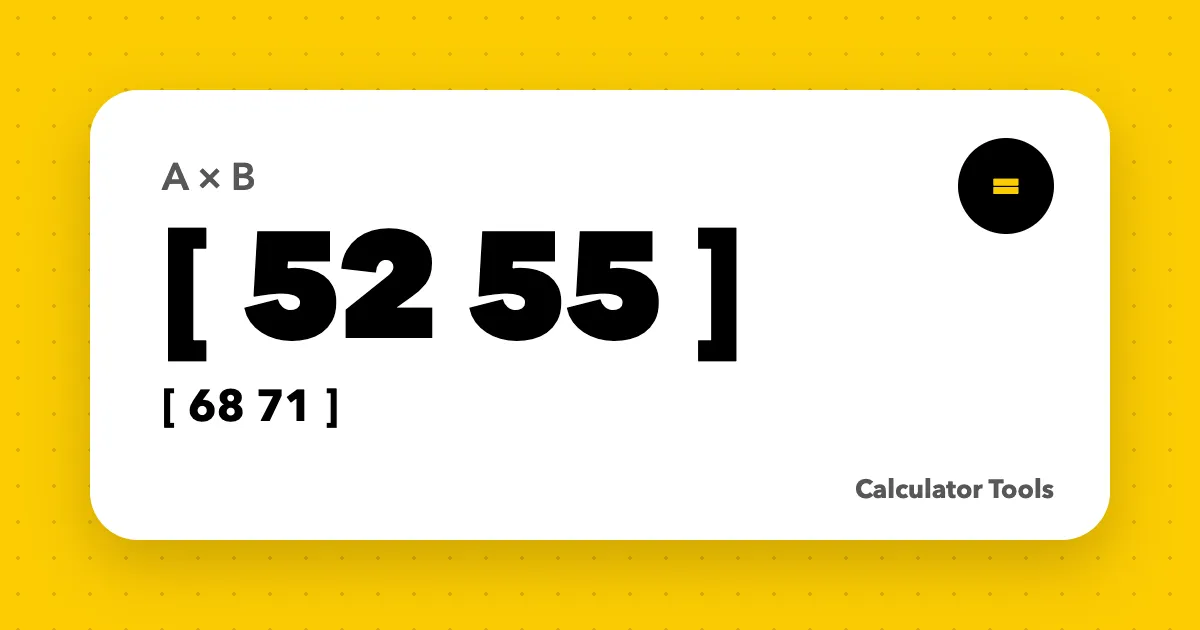
Let A = [[3, 7], [4, 9]] and B = [[8, 2], [4, 7]].
Each entry is a row times a column:
- Row 1 × column 1: 3·8 + 7·4 = 24 + 28 = 52
- Row 1 × column 2: 3·2 + 7·7 = 6 + 49 = 55
- Row 2 × column 1: 4·8 + 9·4 = 32 + 36 = 68
- Row 2 × column 2: 4·2 + 9·7 = 8 + 63 = 71
So A × B = [[52, 55], [68, 71]].
The order matters
Matrix multiplication is not commutative. B × A is [[32, 74], [40, 91]], which is different from A × B. It is, however, associative: (A × B) × C equals A × (B × C).
Adding and subtracting
For addition and subtraction, both matrices must be the same size. Add or subtract the entries in the same position. A + B = [[11, 9], [8, 16]], and A − B = [[−5, 5], [0, 2]].
The determinant of a 2 × 2 matrix
For [[a, b], [c, d]], the determinant is a·d − b·c. For A, that is 3·9 − 7·4 = 27 − 28 = −1.
The inverse
A square matrix has an inverse only when its determinant is not zero. For a 2 × 2 matrix the inverse is (1 ÷ determinant) times [[d, −b], [−c, a]]. For A, the determinant is −1, so the inverse is [[−9, 7], [4, −3]]. Multiplying A by its inverse gives the identity matrix, [[1, 0], [0, 1]].
Useful rules
- (A × B)ᵀ = Bᵀ × Aᵀ
- det(A × B) = det(A) × det(B)
- A × I = A, where I is the identity matrix
Check your answers
Our matrix calculator multiplies, adds, transposes, and finds determinants, inverses, rank, and row reduced form, with the steps shown.