What Is a Limit in Calculus? A Plain-English Guide
Understand limits in calculus: what they mean, how to find them with substitution, factoring, and L’Hôpital’s Rule, and when a limit does not exist.
A limit describes where a function is heading as its input gets close to a value. The function does not need to be defined at that value. Limits are the foundation of derivatives, integrals, and continuity.
An example
The expression (x² − 4) ÷ (x − 2) cannot be evaluated at x = 2, because it gives 0 ÷ 0. Yet as x gets closer to 2 the values get closer to 4. We write this as:
lim as x → 2 of (x² − 4) ÷ (x − 2) = 4
Method 1: direct substitution
Always try it first. If replacing x with the value gives a number, that number is the limit. For 2x + 1 as x → 3, the limit is 7.
Method 2: factor and cancel
If substitution gives 0 ÷ 0, factor and cancel. The numerator x² − 4 factors as (x − 2)(x + 2). Cancel x − 2 and you are left with x + 2, which is 4 at x = 2.
Method 3: L’Hôpital’s Rule
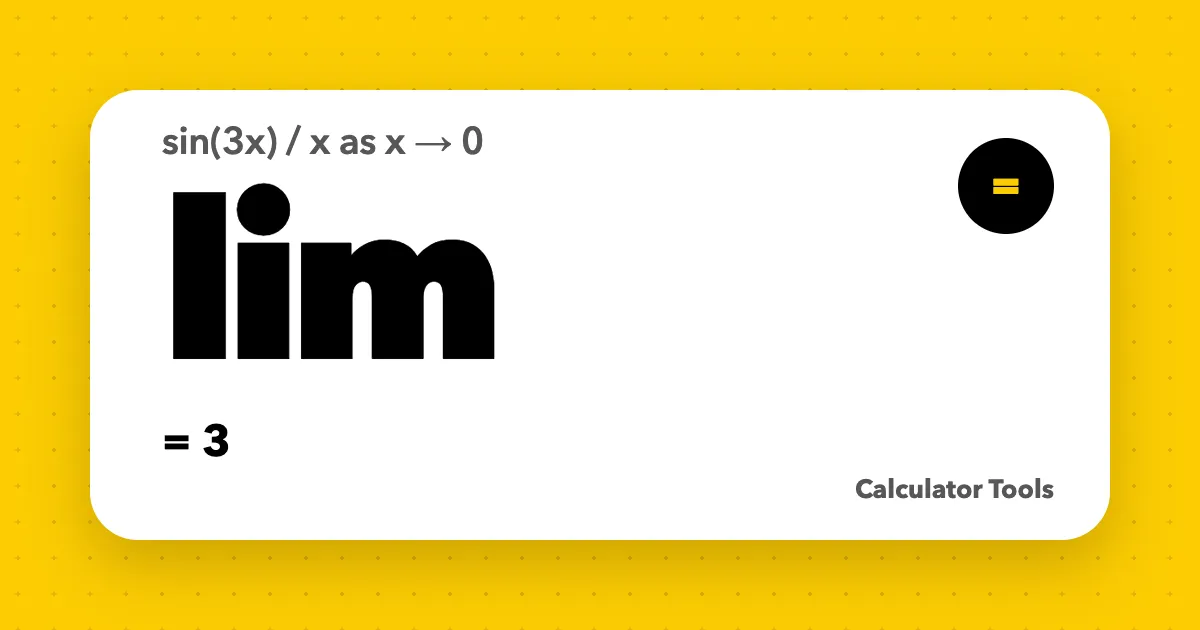
For 0 ÷ 0 or ∞ ÷ ∞, differentiate the numerator and denominator separately, then take the limit again. For sin(3x) ÷ x as x → 0, the new fraction is 3cos(3x) ÷ 1, which is 3 at x = 0.
One-sided limits
The left-hand limit uses values smaller than the point, and the right-hand limit uses values larger than it. A two-sided limit exists only when both sides agree.
For 1 ÷ x at 0, the right-hand limit is ∞ and the left-hand limit is −∞, so there is no two-sided limit. For |x| ÷ x at 0, the left side is −1 and the right side is 1, so again the limit does not exist.
Limits at infinity
A limit as x → ∞ asks what a function does for very large x. For a ratio of polynomials, compare the highest powers. In (3x² + 2x) ÷ (5x² − 1), the degrees match, so the limit is the ratio of the leading coefficients: 3/5.
When a limit does not exist
- The two one-sided limits are different.
- The function swings up and down forever, like sin(1/x) at 0.
- The values grow toward ∞ on one side and −∞ on the other.
- The function is not defined on one side of the point.
Check your work
Evaluate the function at points very close to the value on each side. If the numbers settle toward one value, you are probably right. Our limit calculator shows the method, a table of values, and a graph.